
How many defects is too many in a building inspection?
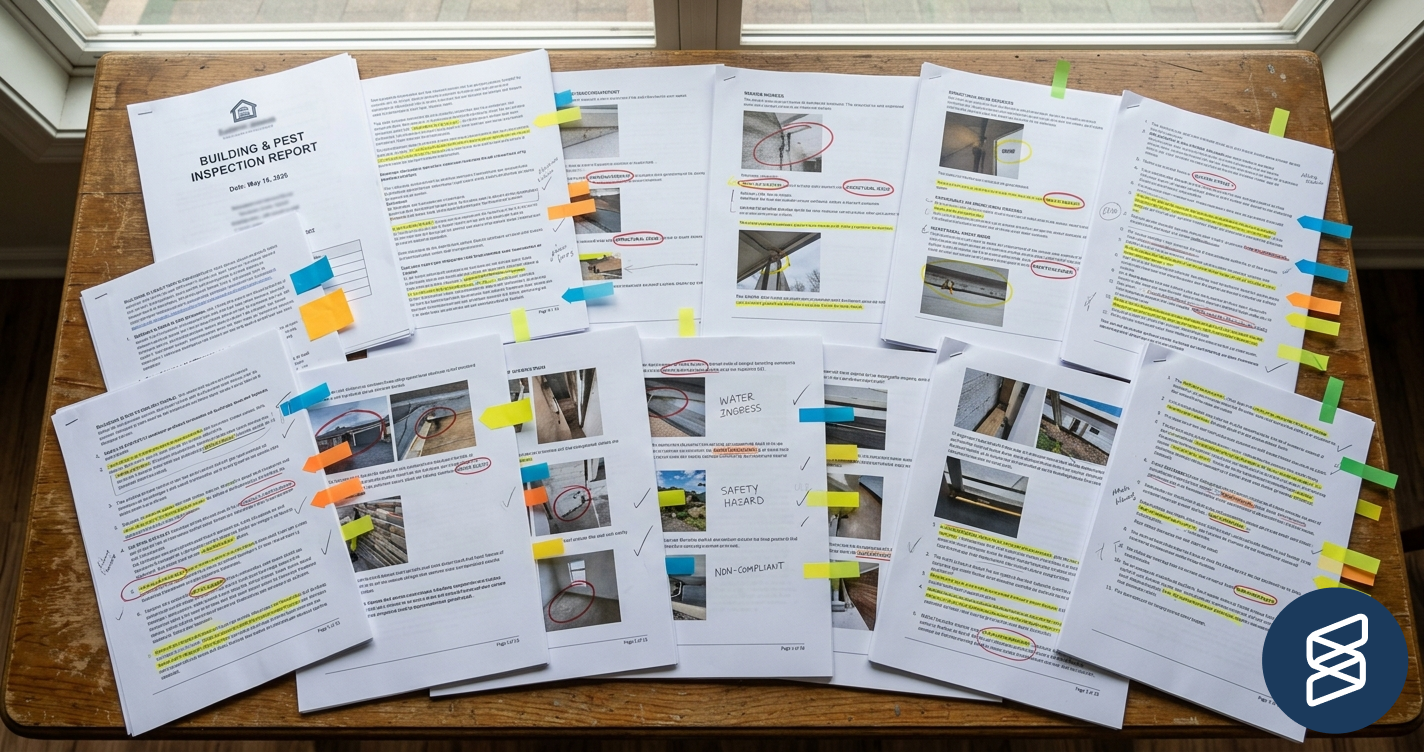
The report arrived this afternoon. Fifty-two pages. You start reading and within ten minutes you've stopped counting findings. There are issues with the roof, the deck framing, three different bathrooms, the subfloor, the electrical, the eaves, the retaining wall, and something the inspector keeps calling "evidence of moisture ingress." You go and find your partner and you both stand in the kitchen and one of you says it out loud: is this just a bad house? Should we walk away?
This article is for that moment. The honest answer is that the question you're asking, the question that feels obvious, is the wrong one. "How many is too many" sounds like it has an answer. It doesn't. The answer depends on what kind of defects, on what age of property, and on whether you've sorted the list properly before reacting to it. Most "too many defects" reports turn out to be a small number of decisions buried inside a long list of normal wear. Some turn out to be money pits. Knowing which one you're looking at is a five-step exercise, not a feeling.
Why "too many" is the wrong question
The phrase "too many defects" lives in your head. It does not live in any building standard, contract clause, or inspector's training. Building inspectors don't grade reports on a count. Conveyancers don't review reports by counting findings. Banks don't withdraw finance based on how long the list is.
What everyone actually evaluates is severity, action timing, and pattern. A report with three findings can fail a property. A report with thirty findings can be entirely normal. The two reports tell you very different things, but you don't know which is which until you look at the columns next to the count, not the count itself.
Count is also misleading because of how reports are written. Some inspectors list every individual instance of a recurring issue. Twelve windows with perished seals appear as twelve rows. Eight cracked roof tiles appear as eight rows. To the inspector this is rigour. To a buyer scrolling through the PDF at 10pm it reads as overwhelming evidence the house is broken. It usually isn't. It's one decision, written down twelve times.
Before you draw any conclusion about whether the house is worth buying, you have to do the sort. The rest of this article is how.
What's actually normal for the age of the property
The single biggest predictor of finding count is the year the house was built. Older houses have more findings. This is not a defect of the house. It is the inspector documenting age-related wear that is real, observable, and expected.
As a rough orientation, on a thorough Australian building inspection:
- New build, 0 to 5 years. 3 to 8 findings is typical. More than 12 on a new build is a real signal, because the warranty period covers many defects and a builder shouldn't be handing over a house with that volume of issues.
- Recent, 5 to 30 years. 8 to 15 findings is typical. Some maintenance, some wear, perhaps a roof or HWS approaching end of life.
- Older, 30 to 80 years. 15 to 30 findings is typical. Expect notes on original window frames, ageing wet area waterproofing, paint, gutters, original wiring or plumbing, subfloor moisture. Most are maintenance, not structural.
- Heritage, 80+ years. 25 to 40+ findings is normal. Original timber, lath and plaster walls, lifted floors, rising damp, perished mortar. A thorough inspector on a federation cottage will easily document forty distinct items.
These ranges are orientation, not rules. The point is that the same finding count tells you completely different things at different property ages. Twenty findings on a 1925 terrace is unremarkable. Twenty findings on a 2018 build is a serious investigation question. Compare the count to the age before you compare it to your fear.
The two numbers that actually matter
Once you stop counting rows, two columns become the only ones that matter: severity and action timing.
Severity ratings vary by inspector but most Australian reports broadly distinguish between major defects (significant, costly, often structural or safety-related) and minor defects (wear, finish, maintenance). Action timing is the second filter: "before settlement," "immediate," "within 12 months," and "monitor and maintain" are the categories you'll see in most reports.
The decision lives in the intersection. Critical or major findings with "before settlement" timing are the items that change the buy decision. They are the items your conveyancer negotiates over, the items where written specialist quotes anchor a price reduction, the items that justify withdrawing under a building and pest condition if the cost stacks too high.
Everything else is either maintenance (your problem once you own it) or longer-horizon items you'll budget for, but they are not deal-makers or deal-breakers. A report with two "before settlement" major defects in a list of twenty findings is a negotiation. A report with twenty "monitor and maintain" findings and no major defects is a healthy report on an older home.
If you do nothing else with your report tonight, do this: open the table of findings and filter, mentally or on paper, to major severity and "before settlement" timing. The list that survives is the conversation.
Volume can also signal a thorough inspector
This part is rarely explained to buyers and it changes how a long report should feel.
A 25-finding report on a 1930s house written by a careful, experienced inspector is more useful than a 5-finding report on the same house written by an inspector trying to keep their pre-purchase clients happy. The first inspector is documenting reality. The second is hiding work from you. The first report lets you make an informed decision. The second hands you problems after settlement.
Long reports often correlate with inspectors who:
- Walk every accessible space (subfloor, roof void, eaves, perimeter, every room)
- Photograph each finding
- Document recurring items separately rather than aggregating them
- Note minor maintenance items that another inspector would skip
- Recommend further investigation where they don't have certainty, rather than guessing
These are features of a good inspection. They produce a longer report, not a worse property. A buyer scrolling a 50-page PDF can mistake thoroughness for catastrophe. Don't.
This is why understanding what's actually in a building inspection report matters more than the page count. The thorough inspector's report is a tool. The thin inspector's report is an absence.
The decision framework: discrete and quantifiable vs systemic and open-ended
Here is the actual call you are trying to make. It is not "how many defects?" It is "are the defects in this report discrete and quantifiable, or systemic and open-ended?"
Discrete and quantifiable defects have a clear scope, a single trade, and a written quote. Replace the deck framing: builder, $12,400. Rectify the non-compliant electrical: electrician, $3,800. Repair the bathroom waterproofing: waterproofer, $4,600. You can stack the costs into a single dollar figure and present it to the vendor's solicitor. Even a long list of these is negotiable, because each line resolves to a number.
Systemic and open-ended defects don't have a defined scope. They use language like "evidence of," "extensive," "throughout the property," "further investigation recommended across multiple areas," "subject to specialist assessment." They require multiple trades, overlapping assessments, and often unknowable totals. The cost may be $8,000 or it may be $80,000 depending on what's behind the wall. You cannot negotiate against an unknowable number.
The decision flows from which side the report lives on. A long list of discrete and quantifiable defects is a negotiation. A short list of systemic and open-ended defects is often a walk-away.
This is the inversion most overwhelmed buyers miss. They count and panic. They should be reading and asking which side of this line each finding falls on.
Red flags that genuinely signal walk away
A handful of patterns in a report mean the volume is real, not perceived. None of them are about count alone.
- Structural movement repeated across the property. "Stepped cracking observed to multiple external walls," "deflection in floor joists in three rooms," "settlement evident to footings." Movement in one place is a finding. Movement in three or four is a building behaviour, not a defect.
- Widespread active termite damage. Active termites in the bearers, frames, and roof timbers, particularly when accompanied by evidence of multiple previous infestations, is a category-changing finding.
- Asbestos in poor condition through occupied areas. Asbestos that is sealed and stable is manageable. Friable asbestos in living spaces, ceilings, or wall sheeting that has been disturbed, drilled into, or is breaking down is a different problem entirely.
- Unapproved or unpermitted work that cannot be legalised. A retrospective approval is sometimes available; sometimes it isn't. Where the report flags non-compliant additions that the council won't approve in their current form, you inherit a legal and insurance problem.
- Multiple systems failing simultaneously. Roof at end of life, hot water at end of life, electrical pre-rewire, plumbing copper corroding. Each one alone is a planned capital cost. Together, on a single property, the total approaches the cost of a serious renovation.
- Repeated "further investigation" recommendations across unrelated areas. A single specialist follow-up is a normal report finding. Five or six recommendations across structural, electrical, plumbing, pest, waterproofing, and roofing is a report telling you the inspector couldn't bound the unknown. Each follow-up is another paid inspection before you'd have certainty.
When you see these patterns, count stops being relevant. The report has told you the defects are systemic. That is the signal to walk, or at least to stop and reassess what the property actually costs.
When a long list isn't actually a problem
Equally important is recognising the long lists that don't change the buy decision. These are common and they panic buyers unnecessarily.
- Older home wear. A 1930s house will have age-related findings throughout. These are not defects in the structural sense. The inspector is doing their job documenting them.
- Recurring single-issue lists. Twelve windows with perished seals is one decision: do you re-seal the windows? The same applies to 8 cracked roof tiles, all gutters needing clearing, all eaves needing repaint. Group recurring items into one line in your head.
- Cosmetic and aesthetic findings. Worn carpet, dated kitchen, scuffed paintwork, tired sealant. Visible at the open home. Not relevant to the decision.
- Long lists of "monitor and maintain" items. Items the inspector recommends watching over time are ownership maintenance, not pre-settlement issues.
If you sort the report and most of what's left after the severity and timing filter falls into one of these categories, the count was misleading. The house is fine. The list is just thorough.
Use the report as a negotiation tool, not a panic trigger
The right response to a long list is rarely to walk. It is to sort, get quotes on the items that survived the sort, and let your conveyancer negotiate from the total. Read how to negotiate after a building inspection for the mechanics. The single most important point: the vendor responds to a written total backed by written quotes, not to the number of rows in the report.
A list of 30 findings with 4 critical items, backed by $18,400 of licensed trade quotes, is a negotiation that almost always lands. A list of 30 minor findings with no quotes is a complaint that goes nowhere. Quotes are the currency.
If you are buying through a private treaty contract with a building and pest condition, your timing matters. The condition window is usually 7 to 14 days. Don't spend the first ten of those panicking. Spend them sorting and quoting.
A practical sort exercise
Here is the sort, in four steps, that turns "too many defects" into a decision.
Step 1: Separate major from minor. Go through the table of findings and mark only the items rated major, critical, or equivalent. Everything else gets set aside for after settlement.
Step 2: Filter to "before settlement" timing. Within the major list, mark only the items the inspector flagged for action before settlement or immediate attention. Items rated "within 12 months" or "monitor" are budgetary, not deal-makers.
Step 3: Group recurring items. If the same defect appears multiple times (perished seals across 12 windows, lifted tiles across 8 roof areas), collapse them into one line with a single trade. You'll be quoting them as one job, not twelve.
Step 4: Get written quotes from licensed trades on each surviving item. Structural cracking gets a structural engineer. Deck framing gets a builder. Plumbing gets a plumber. Electrical gets an electrician. Active pest activity gets a licensed pest controller. Total the quotes.
What you're left with is a one-page summary: a small set of items, each backed by a number. That summary is the actual report. The original PDF is just the source material.
If you've done this and the total is reasonable relative to the property's purchase price, you have a negotiation. If it isn't, or if the items can't be quoted because they're systemic, you have a walk-away. The four-step sort is the decision, not the gut feeling at 10pm.
A note on the emotional half
There is a moment, on the night you receive a long inspection report, where the impulse to act is strong and the information is incomplete. Resist it.
Do not call the agent that night. Do not tell them you're walking. Do not start a stressed conversation that closes negotiating doors before you've even sorted the report. Sleep on it. Read it again in the morning. Send your conveyancer the report and ask them to flag the items that change the buy decision. The conveyancer has seen hundreds of reports. They know what the threshold looks like.
The "too many defects" feeling is mostly an emotional response to information density, not to genuine evidence the house is broken. The sort cures it most of the time. The remaining cases, where the sort confirms systemic failure, are real, and walking away from them is exactly what the report is for.
The pre-purchase inspection process exists so buyers can make this call deliberately. Use it that way.
If you're staring at a 50-page report tonight
The hardest part of "too many defects" is the sorting. Reports are long, dense, full of jargon, and not designed for emotional buyers reading them at home. The severity column may be inconsistent. The action timing may be implicit rather than spelled out. Recurring items may not be grouped. The major defects may be buried on page 34.
Snagger does the sort for you. Every finding rated by severity, sorted by urgency, with recurring items grouped and major defects pulled to the top. The 50-page PDF turns into the one-page summary you actually need to make the call. See what that looks like on a real report.
The report has the information. The question is whether you can see it clearly enough, fast enough, to make a calm decision.
Long report, short timeline?
Upload your Australian building or pest report and get every finding sorted by severity, with recurring items grouped, major defects flagged, and 'before settlement' items pulled to the top. The 50-page report, condensed to what matters.
Upload your reportSnagger is a comprehension aid only. This article is general information and does not constitute professional building, legal, or financial advice. Always consult a licensed building inspector, conveyancer, or other qualified professional before making any purchasing decision.
More articles

Should I get a building inspection before buying at auction in Australia?
Auctions in Australia are unconditional. Here's why a pre-auction building inspection matters, how to arrange one, and what to do if it finds problems.

First home buyer checklist Australia: from pre-approval to settlement
The full first home buyer journey, broken into stages with tickable checkboxes. From saving a deposit to settlement day, everything you need in order.

The 2026 budget and property: what the changes mean if you're buying a home in Australia
The 2026 Federal Budget reshaped negative gearing and CGT on established property. Here's what it means if you're buying a home, and why building inspections matter more now, not less.