
Is rising damp serious when buying a house in Australia?
You found it on page 31. Between a note about the guttering and a paragraph about the bathroom exhaust fan, your building inspection report mentions rising damp in the lower walls. Maybe it says "evidence of rising damp," maybe "suspected rising damp," maybe "recommend further investigation for moisture ingress consistent with rising damp." And now you're on your phone at midnight trying to work out whether this house is slowly rotting from the ground up.
The short answer: rising damp is a real issue that ranges from cosmetic nuisance to serious structural problem, depending on how far it's progressed, what the walls are made of, and whether the original damp-proof course has failed. It is not a reason to automatically walk away from a house. But it is a reason to understand what you're looking at before you settle.
What rising damp actually is
Rising damp is ground moisture being drawn upward through porous masonry - brick, stone, morite block - by capillary action. Think of the wall as a sponge standing in a shallow tray of water. The moisture wicks up through the tiny pores in the masonry, carrying dissolved salts with it. When the moisture evaporates from the wall surface (inside or outside), the salts are left behind as white crystalline deposits called efflorescence.
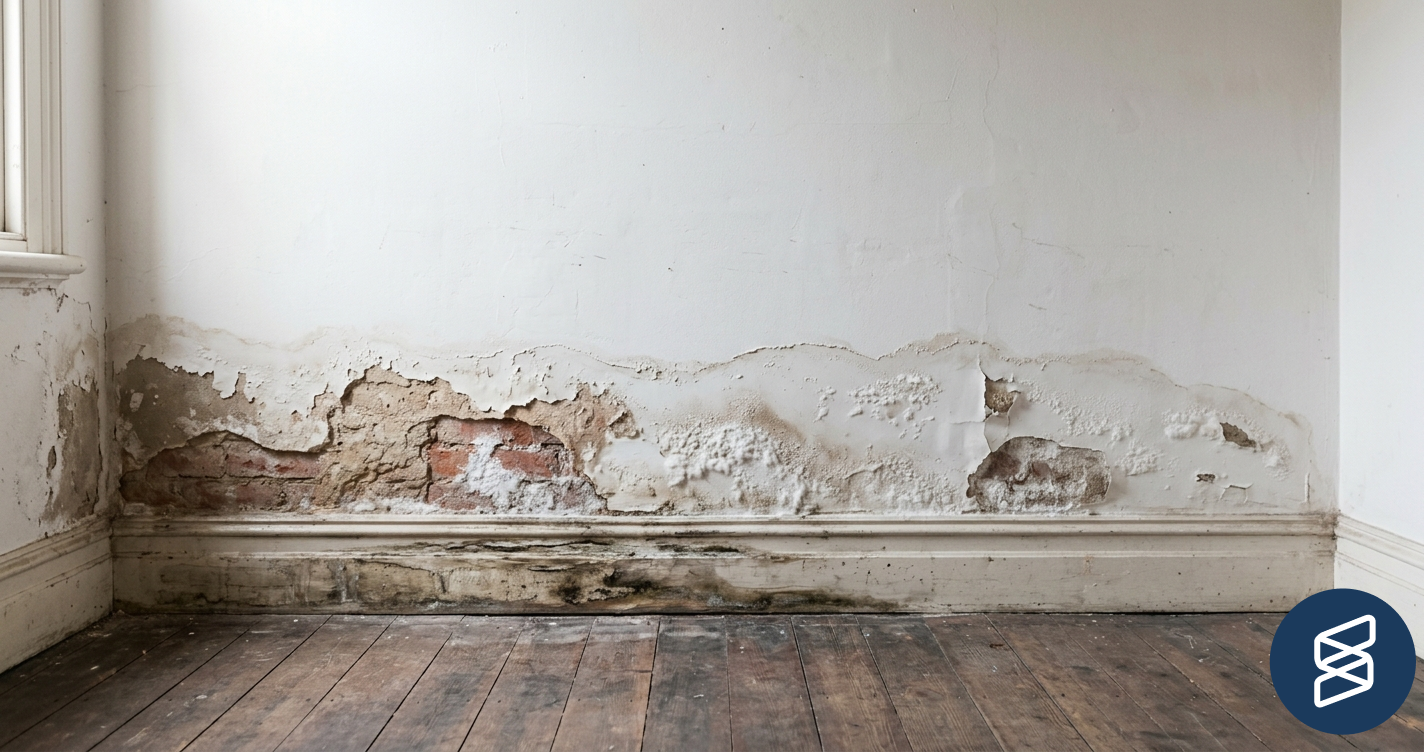
The moisture typically rises to a height of about 1 to 1.5 metres, though in severe cases it can go higher. The visible signs are usually concentrated in a band along the lower section of the wall: peeling paint, bubbling plaster, staining, salt deposits, and a tide-mark where the damp zone meets dry wall above.
Rising damp is different from other types of moisture:
- Condensation forms on cold surfaces (windows, external walls in winter) and is an airflow problem, not a structural one.
- Penetrating damp comes from outside: a leaking roof, failed flashing, cracked render, faulty guttering. It can appear anywhere on the wall, not just at the base.
- Rising damp always starts at ground level and moves upward. If the moisture is only at the top of the wall or around a window, it's not rising damp.
Inspectors know the difference. When your report says "rising damp," they mean moisture entering from below through the masonry itself.
How to tell if you have rising damp
Rising damp produces a recognisable pattern of damage concentrated at the base of walls, not the top. Here's what to look for when inspecting a property.
Dark patches on the lower walls
- Dark or discoloured patches on the lower section of internal walls - often the earliest visible sign before paint or plaster damage appears
- Walls that feel cold or damp to touch at the base, even in dry weather
Paint and plaster on the lower walls
- Peeling paint or bubbling plaster in the bottom metre or so of the internal wall
- Lifting, blistering, or stained wallpaper near the base of the wall (common in older Australian homes with original wallpaper)
- A tide-mark, a horizontal band where damp meets dry wall above, typically 1 to 1.5 metres from the floor
Salt deposits on the wall surface
- White crystalline deposits (efflorescence), the residue salts leave behind when moisture evaporates out through the surface
- Chalky or powdery staining concentrated in the lower wall zone
Mould at the base of the wall
- Black or green mould patches on the lower section of internal walls, particularly behind furniture or in poorly ventilated rooms
- This differs from general bathroom or window mould, which is usually condensation. Mould concentrated at the base of an external wall is a rising damp signal.
Mortar and brickwork (more advanced cases)
- Mortar joints that look soft, recessed, or are visibly crumbling between bricks
- Spalling, where the face of bricks is flaking away from the wall surface
Skirting boards and nearby timbers
- Skirting boards that feel soft at the base or show discolouration and lifting
- Door frames or floor joists near the affected wall showing early signs of rot
Smell
- A persistent musty smell in the room that doesn't clear with ventilation
All of these signs concentrate at the base of the wall. If the damage is at the top of the wall, near windows, or along the ceiling, you're likely looking at penetrating damp or condensation - not rising damp.
Visible signs like these are suggestive, not diagnostic. A specialist's moisture test - typically a calcium carbide or gravimetric test - is the only way to confirm the source is ground moisture rather than a leak or condensation from elsewhere.
Why some houses get it and others don't
Most modern Australian homes don't get rising damp because they're built with a damp-proof course (DPC), a physical or chemical barrier installed in the wall near ground level during construction that stops moisture from wicking up. In newer homes this is usually a polyethylene membrane or a bituminous sheet laid between courses of brickwork.
Rising damp becomes an issue when:
The original DPC has failed. In homes built before the 1970s, the DPC was often a layer of slate, lead, or bitumen that has deteriorated over 50+ years. Once it breaks down, there's nothing stopping the ground moisture from rising.
There was never a DPC. Some very old homes, particularly Victorian and Edwardian terrace houses, were built without any damp-proof course at all. This is especially common in inner Melbourne (Fitzroy, Carlton, Collingwood, Richmond), inner Sydney (Surry Hills, Glebe, Newtown, Balmain), and Adelaide's older suburbs.
The DPC has been bridged. This is the sneaky one. The DPC might be intact, but someone has rendered over it, piled soil against the wall above it, or laid a path or patio that sits above the DPC line. The moisture simply goes around the barrier. Garden beds built up against the house are the most common culprit.
The subfloor drainage is poor. If water pools under or beside the house, from blocked stormwater, poor site grading or broken agricultural drains, the moisture load on the base of the walls is much higher than it should be. This accelerates rising damp even in walls with a functioning DPC.
Which Australian homes are most at risk
Rising damp follows the building stock, and certain cities have much more of it than others.
Melbourne has the highest incidence of rising damp of any Australian capital. The inner suburbs are full of Victorian and Edwardian brick terraces and cottages built between 1870 and 1920, many without a DPC or with one that failed decades ago. The clay soils across Melbourne's inner and eastern suburbs hold moisture close to the surface, which makes things worse. If you're buying in suburbs like Fitzroy, Brunswick, Northcote, Collingwood, Carlton, Richmond, Prahran, or South Melbourne, rising damp on the inspection report is extremely common and shouldn't surprise you.
Sydney has a similar pattern in inner-west and inner-south suburbs, including Balmain, Glebe, Newtown, Surry Hills, Redfern, Marrickville, where sandstone and early brick terraces are common. Sydney's higher humidity also contributes, though the sandstone common in older Sydney homes handles moisture differently from Melbourne's softer bricks.
Adelaide has significant rising damp in its older bluestone and brick homes, particularly in inner suburbs like Norwood, Unley, Prospect, and North Adelaide. The sandy soils help with drainage in some areas but the age of the building stock, some of it pre-dating 1880, means DPCs are often absent.
Brisbane and Perth see less rising damp because the building stock is younger on average and construction methods differ. Queenslander-style homes raised on stumps have an airflow gap that reduces ground moisture contact. Perth's sandy soils drain well. That said, rising damp can still appear in older brick homes in both cities, particularly those built directly on slabs without adequate moisture barriers.
Hobart and Canberra have older pockets of building stock where rising damp appears, but it's less common overall.
How serious is it, really?
This is the question. And the honest answer is: it depends on how far it's progressed.
Cosmetic only. At the mild end, rising damp causes peeling paint, bubbling plaster, and salt staining on the lower walls. The masonry itself is still sound. The mortar joints are intact. The wall is damp but not degraded. At this stage, treatment is relatively straightforward and the house is not structurally compromised.
Moderate. The damp has been present long enough that mortar joints are softening, plaster is crumbling when touched, and there's visible salt damage (efflorescence and subflorescence, meaning salts forming behind the surface and pushing the render off). Timber elements in contact with the damp zone, such as skirting boards, door frames and floor joists near the wall, may show early signs of rot. This needs treatment, and the longer you wait, the worse it gets.
Serious. The mortar between bricks is actively crumbling. The masonry itself is "spalling" - the face of the bricks is flaking off. Timber framing members embedded in or near the damp wall are rotting. There's a musty smell that doesn't go away. The wall may be losing structural integrity. At this stage you're looking at significant remediation: damp-proof course installation, replastering with salt-resistant render, possible repointing of brickwork, and replacement of affected timbers.
Your inspection report may classify rising damp as a major defect or as a defect requiring further investigation. Either way, you need a specialist to assess which of these three stages you're dealing with. The inspector can see the symptoms. The specialist tells you the prognosis.
What to do next
1. Get a rising damp specialist, not just any builder.
Rising damp assessment and treatment is a niche within the building trades. You want someone who specifically deals with damp-proof course installation, not a general builder who'll quote you to "just replaster it." A good damp specialist will:
- Use a calcium carbide or gravimetric moisture test (not just a surface pin meter, which can give misleading readings)
- Assess whether the damp is truly rising damp or something else (condensation, penetrating damp, plumbing leak)
- Check whether a DPC exists and whether it's been bridged
- Provide a written report with findings and a scope of remediation
Search for "rising damp specialist" or "damp-proof course installer" in your city. In Melbourne, Sydney, and Adelaide there are firms that do nothing else.
2. Check whether external factors are making it worse.
Before you spend money on a chemical injection DPC, check the basics. These are things you or the inspector may have already noticed:
- Is the soil or a garden bed built up above the DPC line? Sometimes the fix is lowering the ground level, not injecting chemicals.
- Is there a blocked or broken stormwater drain increasing the moisture load?
- Has someone rendered or concreted over the DPC, bridging it?
- Is the subfloor ventilation blocked or inadequate?
Fixing these can dramatically reduce the severity of rising damp, and in some cases resolve it entirely without a new DPC.
3. Use the specialist's report to negotiate.
If the specialist confirms rising damp and provides a remediation scope, you now have a concrete basis for negotiation with the vendor. Your options are the same as with any major defect:
- Request the vendor rectify before settlement
- Request a price reduction equal to the remediation cost
- Accept the finding and proceed, knowing the cost you'll bear after settlement
Your conveyancer handles the formal request. The specialist's written report is your evidence.
A common trap: "it's just cosmetic"
If the vendor or the agent tells you rising damp is "just cosmetic" or "just needs a coat of paint," be cautious. Paint over rising damp doesn't fix it - it hides it temporarily until the moisture pushes through again, usually within 6 to 18 months. The salts continue to build up behind the surface, doing more damage out of sight.
The only way to know whether it's truly cosmetic or something deeper is the specialist assessment. Don't take someone else's word for it when they have a financial interest in you settling.
If your report flagged rising damp
Your inspector flagged it for a reason. Rising damp doesn't appear in a report by accident. The inspector saw moisture patterns, salt deposits, or damage consistent with it, and decided it was significant enough to document. Whether it's a line in the report or a full paragraph with photos, the next step is always the same: get a specialist to assess the extent and give you numbers.
If your report has rising damp alongside other findings, like major defects, items requiring further investigation, things to sort before settlement - and you're trying to make sense of it all, Snagger translates Australian building and pest inspection reports into plain English. Every finding explained, severity rated, matched to the right trade. Have a look at a real sample report to see what the full breakdown looks like.
The house might be perfectly fine. But you need to know, not guess.
Rising damp flagged in your report?
Upload your Australian building or pest inspection report and get rising damp and every other finding explained: what it means, who to call, and what to ask.
Upload your reportSnagger is a comprehension aid only. This article is general information and does not constitute professional building, legal, or financial advice. Always consult a licensed building inspector, conveyancer, or other qualified professional before making any purchasing decision.
More articles

Should I get a building inspection before buying at auction in Australia?
Auctions in Australia are unconditional. Here's why a pre-auction building inspection matters, how to arrange one, and what to do if it finds problems.

First home buyer checklist Australia: from pre-approval to settlement
The full first home buyer journey, broken into stages with tickable checkboxes. From saving a deposit to settlement day, everything you need in order.
How many defects is too many in a building inspection?
Your building inspection report has 20 findings and you're wondering if it's a walk-away report. Here's how to sort signal from noise when the list is long.