
How much does a building and pest inspection cost in Australia?
You've got the contract in front of you, you've negotiated yourself to a number you can almost stomach, and someone, your conveyancer or your dad or the agent, has told you you need a building and pest inspection. So you start ringing around. The first quote is $385. The second is $720. The third one quotes you $1,400 and asks whether the property is over 100 square metres. By the fourth call, you have no idea whether you're being ripped off, or whether the cheap one is the one ripping you off.
This is the question almost every first home buyer hits at the same point in the process: how much should this actually cost?
The short version: in Australia, a combined building and pest inspection on a standard residential property usually costs between $400 and $800. Capital cities tend to be at the upper end. Regional towns tend to be at the lower end. Older or larger properties, properties with difficult access, and properties in termite-prone areas often push past $800. At the prestige end, inspections on large heritage or multi-million-dollar properties routinely run $1,500 to $3,500 or more. The cheapest inspections, generally under about $350 for a combined report in a capital city, are usually cheap for a reason, and the reason is rarely good news for the buyer.
Building and pest inspection cost summary
These are the typical building and pest inspection cost ranges buyers encounter across Australia in 2026. Property size, age, and location all shift the number - these are the middle-of-market figures for each category.
By inspection type
- Combined building and pest inspection cost: $400 to $800 typical, $1,000 or more for prestige or older properties
- Building inspection only cost: $300 to $600
- Pest inspection only cost: $200 to $400
By property type
- Apartment building inspection cost: $350 to $500
- Single-storey house building and pest inspection cost: $400 to $700
- Double-storey house building and pest inspection cost: $500 to $900
- Heritage or pre-1970s home building and pest inspection cost: $700 to $1,500
By capital city
- Sydney building and pest inspection cost: $700 to $1,000 inner suburbs, $500 to $800 outer suburbs
- Melbourne building and pest inspection cost: $600 to $900 inner suburbs, $450 to $700 outer suburbs
- Brisbane building and pest inspection cost: $450 to $750
- Perth building and pest inspection cost: $400 to $650
- Adelaide building and pest inspection cost: $350 to $600
Other costs to know
- Rush turnaround surcharge: $100 to $200 extra for same-day reports
- Travel surcharge for regional inspections: typically $50 to $200 depending on distance
What a building and pest inspection actually costs in Australia
There are three pricing tiers most Australian buyers will encounter when they ring around for an inspection.
Building only ($300 to $600). The inspector walks through the property, assesses the structural elements, the roof, the subfloor (where accessible), the services to the extent visible, and writes a report. No pest assessment.
Pest only ($200 to $400). A licensed pest inspector checks for active and past termite activity, signs of borer, rot, and conducive conditions like timber-to-soil contact and inadequate subfloor ventilation. No structural or building-defect assessment.
Combined building and pest ($400 to $800 typical, $1,000 to $1,500 for larger or older properties, $1,500 to $3,500 or more for large prestige homes). Most buyers go with this option. It's cheaper than booking two separate inspections, the inspectors are often working together or are the same person dual-qualified, and the reports are usually delivered together. The prestige-end pricing is covered in its own section below.
A small minority of buyers also commission specialist inspections at extra cost: structural engineering reports for serious cracking, asbestos testing for older properties, methamphetamine residue testing, or thermal imaging. None of these are part of a standard building and pest inspection.
Typical ranges by state
The same property can cost different amounts in different cities, partly because of cost-of-living differences and partly because demand and competition vary. These are rough ranges based on what most inspectors charge for a standard residential property in 2026.
New South Wales. Sydney inspections are at the top end nationally. Combined building and pest inspections on inner-Sydney houses commonly land between $700 and $1,000. Outer suburbs and regional NSW usually run $500 to $800. The combination of high demand, high property values, and older Federation and Victorian housing stock pushes the average up.
Victoria. Melbourne metro is similar to inner Sydney for older homes, with combined inspections often $600 to $900. Inner-Melbourne Edwardians and Victorians are time-consuming to inspect, which the price reflects. Outer suburbs and regional Victoria are more like $450 to $700.
Queensland. Brisbane and the Gold Coast tend to run $450 to $750 for a combined inspection. The pest component is the larger driver here than in southern states, because termite activity is far more prevalent. Some Queensland inspectors charge a small premium for properties on stumps, where the subfloor inspection is more involved. Regional Queensland is often $400 to $650.
Western Australia. Perth combined inspections typically run $400 to $650, with regional WA usually $350 to $550. Less old housing stock and lower competition pressures keep prices a touch lower than the eastern capitals.
South Australia. Adelaide is one of the more affordable capital cities for inspections, often $350 to $600 for combined. Regional SA is similar.
Tasmania, ACT, Northern Territory. Smaller markets, more variation. Combined inspections generally land $400 to $700 in Hobart, Canberra, and Darwin. Fewer inspectors mean less competition, which can keep prices stable but turnaround longer.
These ranges are not promises. Always get at least two quotes before you commit, and don't assume the highest quote is the most thorough or the lowest is the cheapest in disguise.
Who pays for a building and pest inspection?
In Australia, the buyer pays for the building and pest inspection - not the seller. The cost is paid directly to the inspection company, typically at the time of booking or after the report is delivered, and is non-recoverable if you walk away from the property after reading the results.
This arrangement exists for a good reason. When the buyer commissions and pays for the inspection, the inspector works in the buyer's interests alone. A buyer-paid inspector has no financial relationship with the vendor and no incentive to produce a clean report that helps a sale proceed. That independence is the whole point.
The exception is vendor-paid pre-sale inspections, where the seller commissions a building and pest report before listing the property and provides it to potential buyers. Vendor reports are becoming more common in Victoria and are permitted in all states. They reduce inspection costs for buyers and can speed up due diligence. The practical limitation is that the vendor chose the inspector and received the report first. Even where the report looks thorough, most conveyancers still recommend that buyers commission their own independent inspection before proceeding.
What does a building and pest inspector cost?
"Building and pest inspector cost" and "building pest inspector cost" mean exactly the same thing as the inspection price - buyers often think of the fee as what the inspector charges for their time rather than what the inspection report costs as a product. The dollar figure is the same either way.
The inspector is paid by the buyer, and the cost follows the same ranges covered above: $400 to $800 for a combined building and pest inspection on a standard residential property, with capital-city rates at the upper end and regional rates at the lower. Experienced inspectors who hold the relevant AS 4349.1 qualifications and carry appropriate professional indemnity typically charge at the middle to upper end of these ranges. That pricing usually reflects genuinely more thorough work - the time on site, the depth of the report, and the availability of the inspector to talk you through the findings after delivery.
The cheapest building and pest inspector cost is not necessarily the best value. An inspector who charges $350 for a combined report in inner Sydney is either spending less time on site than the inspection warrants, producing a thinner report, or both.
When inspections cost $1,500 or more
The standard $400 to $800 range applies to typical residential properties: three- or four-bedroom houses, built post-1960, on accessible blocks. As you move up in property value, age, or complexity, the inspection cost climbs sharply. Combined building and pest inspections on prestige properties routinely run $1,500 to $3,500, and sometimes more.
If you're buying a $5 million house in a Mosman, Toorak, New Farm, or Cottesloe-style suburb, expect to pay a multiple of what a standard suburban inspection would cost. Five things drive the increase.
Time on site. A 600-square-metre house with a pool, double garage, multiple decks, an outbuilding or studio, and landscaped grounds is a four- to six-hour inspection, not 90 minutes. The base rate for the inspector's time scales with the actual hours the property requires.
Heritage and non-standard materials. Many high-end Sydney and Melbourne homes are Federation, Edwardian, or Victorian. They have slate or terracotta roofs, lath-and-plaster walls, tessellated floors, lead flashing, and original electricals. Inspecting these materials requires specific expertise and takes longer than running through a 2018 brick-veneer build.
Multiple access points. Larger properties often have more than one roof space, more than one subfloor access point, and additional structures (pool houses, granny flats, separate garages) that each need their own inspection sweep.
Specialist sub-reports. A multi-million-dollar purchase frequently bundles in additional reports: a structural engineer's assessment, an asbestos audit, an electrical compliance test, a pool or spa fencing certification, sometimes a heritage-fabric report. Each of these adds $400 to $1,500. Some inspectors quote a "premium" combined service that includes a couple of these by default.
Liability and professional indemnity. Inspectors carry indemnity insurance, and the policy cost reflects the value of the properties they assess. The exposure on an $8 million harbourfront purchase is materially higher than on a $700,000 outer-suburb purchase, and the inspector's pricing reflects it.
If your inspector quotes you $400 for a five-bedroom heritage home on a large block, that's a red flag, not a bargain. Either they're not delivering an AS4349-grade inspection, or they don't have appropriate indemnity for that price point. Ask for a sample report, and ask explicitly whether their professional indemnity covers the property's purchase price.
What actually changes the price
If two inspectors quote you wildly different prices for the same property, the difference usually comes down to one of the following.
Property size. A 90-square-metre two-bedroom unit takes less time than a 280-square-metre four-bedroom house. Most inspectors price by floor area, room count, or time on site. A larger property is genuinely more work to inspect properly, so a higher price isn't always padding.
Property age. A 2018-built house has standard materials, no asbestos, modern wiring, and a recent compliance trail. A 1910 weatherboard cottage has potentially asbestos-containing materials, old electrics, lath-and-plaster walls, settling foundations, and a roof structure that's been patched repeatedly over a century. The older property takes more time and more expertise.
Property type. Single-storey houses are the cheapest. Double-storey, split-level, or multi-level properties are more involved because the inspector has to access more roof spaces, more wall sections, and more decks or balconies. Apartments are sometimes cheaper because there's no roof, subfloor, or external structure for the buyer to assess (the body corporate handles those).
Location and access. Inspectors charge for travel. A regional property an hour outside the city is usually a flat or per-kilometre travel surcharge. Properties with restricted subfloor access, no roof access, locked gates, or steep blocks may attract a small premium because the inspection takes longer.
Turnaround time. Standard turnaround is 24 to 48 hours from inspection. If you need a same-day or next-morning report (because your contract condition deadline is closing in), most inspectors charge a rush fee, often $100 to $200 on top of the base price. Plan ahead if you can.
Combined or separate. Booking the building inspection and the pest inspection together with the same provider is almost always cheaper than two separate appointments. If you book separately, expect to pay roughly 75 to 90 per cent of the full standalone price for each.
Termite-prone region. In subtropical and tropical Australia, pest inspectors spend more time on the termite assessment, including thermal or moisture-meter checks. The pest component of a combined inspection in Brisbane is typically more thorough (and more expensive) than the pest component in Hobart.
What you should actually be getting for the money
This is where the gap between cheap and expensive inspectors usually shows up. Two inspectors can charge $400 and $800 for the same property and deliver dramatically different reports. Here's what a properly priced inspection should include.
A written report compliant with Australian Standard AS 4349.1 (and AS 4349.3 if pest is included). The report should be 30 to 60 pages or more for a standard property, with sections covering interior, exterior, roof exterior, roof space, subfloor, site, and services. If your "report" is two pages with bullet points, you're not looking at an AS4349 inspection.
Photographs. Every significant finding should have at least one photo. Modern inspectors include 30 to 100 or more photos in a standard report. Photos let you (and your conveyancer, and any specialist tradie you bring in later) see what the inspector saw without having to revisit the property.
Severity classifications. Findings should be classified, usually as major defect, minor defect, or recommend further investigation. Without these classifications, you have no way to triage which items matter.
Per-finding recommendations. Each defect should have a recommended next step: rectify before settlement, address within 12 months, monitor, or refer to a specific licensed trade. Generic recommendations like "consult a builder" aren't useful.
A written summary at the front. A two- or three-paragraph plain-English summary of overall condition, the most important findings, and the most urgent items. Some inspectors call this an executive summary. It should not just say "fair to average condition for age and type" without elaboration.
For pest inspections specifically. Findings on current or past termite activity, conducive conditions, mud leads, and timber damage. Photos of any termite evidence. A clear statement on whether termite activity is currently present, present in the past, or not detected.
A consultation phone call after delivery. Most reputable inspectors will spend 15 to 30 minutes on the phone with you walking through the major findings. This is usually included in the price for any decent operator. If your inspector won't take your call after delivering the report, that's a sign of a low-quality operator.
If you've paid $700 for an inspection and you've received a four-page bullet-point report with no photos and no inspector willing to talk to you, you've been overcharged for nothing useful. If you've paid $400 and received a 60-page properly classified report with photos and a follow-up call, you've been served well.
Red flags for cheap inspections
The cheapest inspection in your area is not automatically a bad one. Some genuinely competitive operators charge below average because they have low overheads or are building a client base. But the lowest end of the market is also where most quality problems show up. Watch for these signs.
- Suspiciously low pricing in a capital city. A $250 combined building and pest inspection in inner Sydney is almost certainly not delivering a proper AS4349 report. The actual time on site for a real inspection is 90 minutes to 3 hours, plus 4 to 8 hours of report writing. The maths doesn't work below a certain price.
- No example report. A reputable inspector will email you a redacted sample report on request. If they can't or won't, you don't know what you're paying for.
- Verbal-only reports. "I'll just give you a call after the inspection" is not an inspection. You need a written report you can hand to your conveyancer and use as a basis for negotiation.
- Generic boilerplate language. Some low-end operators use template reports with the same paragraphs cut and pasted across every property. You can usually spot this because the report says nothing specific about the actual property.
- Pest inspectors who also offer treatment. A pest inspector whose business model is selling termite treatments has a financial incentive to find issues. A genuinely independent pest inspector doesn't sell treatments. Check the company website.
- The vendor's recommended inspector. The agent suggesting their preferred inspector is not always corrupt, but the conflict is real. The agent is the vendor's representative. Their inspector recommendation may favour quick clean reports that don't kill deals. Use someone you found independently.
- Same-day turnaround at full speed for a low price. Quality inspections take time to write. A 60-page report with photos and analysis isn't done in an hour. If the price is low and the turnaround is instant, the report quality usually isn't there.
When it's worth paying more
Sometimes the right answer is the more expensive quote. Pay more if:
- The property is older than 1970, especially if it's pre-war. Older homes have more variables: asbestos materials, dated wiring, lead paint, settling foundations, structural alterations of unknown legality. A more thorough inspector spends the time these properties require.
- The property has had previous renovations or extensions, especially if you're not sure they were council-approved. Non-compliant work is one of the most common buyer-side problems and a careful inspector catches it.
- You're buying in a termite-prone area, especially Queensland, northern New South Wales, or northern Western Australia. The pest component of the inspection matters more here than the building component, and cheap pest inspectors in these regions are particularly risky.
- You're buying as an investment, especially interstate or overseas. You're not going to be living there. The inspector is your eyes. Pay for a thorough one.
- You're buying a higher-value property. The cost difference between a $500 inspection and an $800 inspection is trivial compared to even a single missed major defect on an $800,000 purchase.
What to do once you have the report
Once the inspection is done and the report's in your inbox, the value of what you paid for shifts entirely to what you do next. The most expensive mistake first home buyers make isn't paying too much for the inspection. It's paying for an inspection and then not properly reading or acting on the findings.
A good inspection report is worth several thousand dollars in negotiating leverage if used properly. A perfectly good $700 report sitting unread in someone's email is worth nothing.
Three things to do as soon as the report lands:
1. Read the building inspection report properly. Not skim. Read every section, including the appendices. The most important findings are sometimes buried in subsections, not in the executive summary.
2. Identify the items that give you negotiating leverage. Critical and major defects, items requiring further investigation, safety issues, and non-compliant work all give you legitimate grounds to negotiate after the building inspection. Cosmetic issues and age-related wear do not.
3. Get specialist quotes for any major findings. A vague "the deck has structural issues" gets you nowhere with the vendor. A licensed builder's quote of $9,200 to replace the framing is something they can respond to.
You've already spent the $400 to $800. Make sure you extract every bit of value from it.
If your report is hard to make sense of
Building inspection reports are written by inspectors for inspectors, working to a national standard that's almost half a century old. They're technically thorough and almost universally hard to read. Most first home buyers spend hundreds of dollars on one and end up with a 50-page PDF they read once, get anxious about, and don't really act on.
If your own report is full of phrases you don't understand, or you've paid for an inspection and you're not sure which findings actually matter, Snagger translates Australian building and pest inspection reports into plain English. Every finding explained, severity rated, matched to the right tradie, with the questions to ask before you sign. You can see what a full analysis looks like on a real report before you upload your own.
The inspection cost was the easy part. The value comes from acting on what's in it.
Have findings in your report you don't understand?
Upload your Australian building or pest inspection report and get every defect explained, severity rated, and matched to the right tradie.
Upload your reportSnagger is a comprehension aid only. This article is general information and does not constitute professional building, legal, or financial advice. Always consult a licensed building inspector, conveyancer, or other qualified professional before making any purchasing decision.
More articles
Should I get a building inspection before buying at auction in Australia?
Auctions in Australia are unconditional. Here's why a pre-auction building inspection matters, how to arrange one, and what to do if it finds problems.
First home buyer checklist Australia: from pre-approval to settlement
The full first home buyer journey, broken into stages with tickable checkboxes. From saving a deposit to settlement day, everything you need in order.
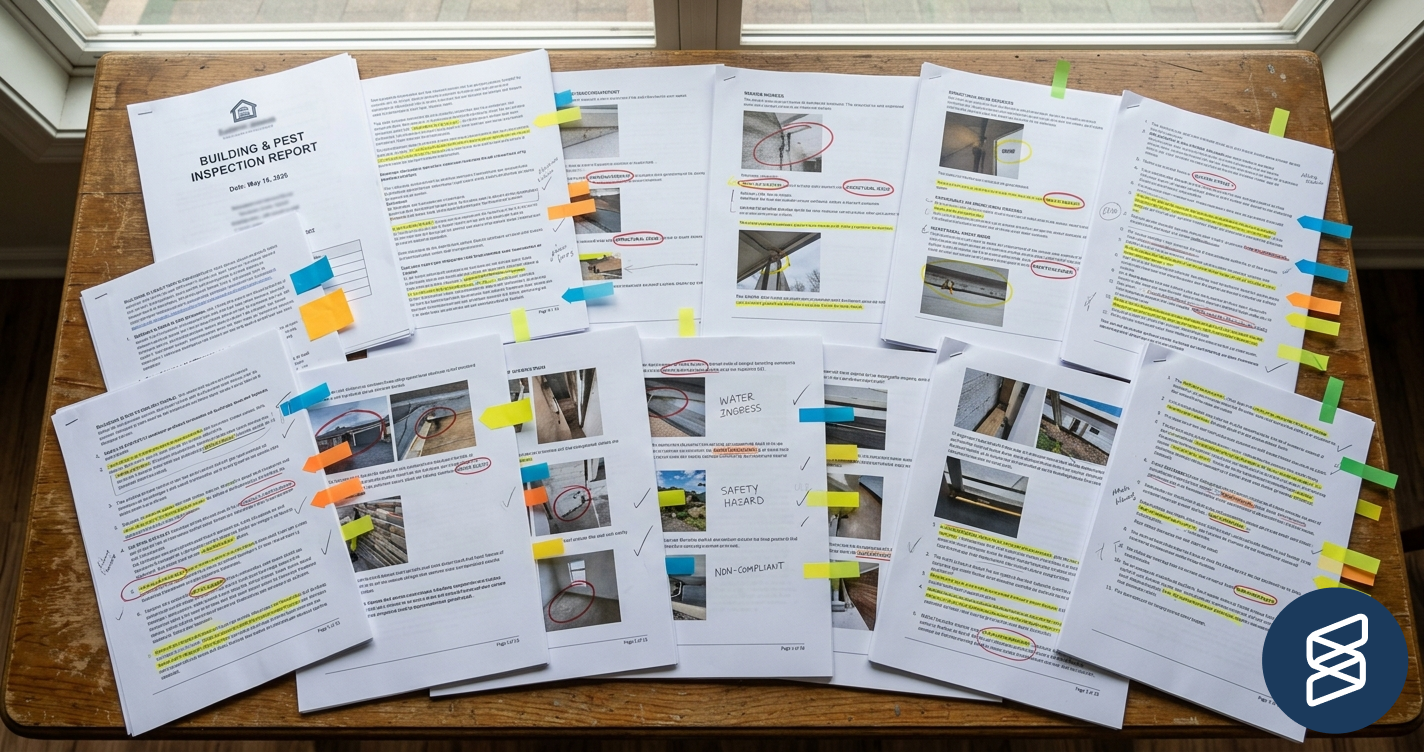
How many defects is too many in a building inspection?
Your building inspection report has 20 findings and you're wondering if it's a walk-away report. Here's how to sort signal from noise when the list is long.